
Picture book
The Candlemakers’ Petition
A story inspired by Frédéric Bastiat (1845)
The characters
- Amélie, a nine-year-old girl who loves drawing in the sunshine
- Her papa, Marcel, the tailor on her street
- Monsieur Bougie, the candlemaker, tall and thin like a candle
- Monsieur Pompon, a deputy with a tall hat and enormous side-whiskers
- Madame Violette, who sells flowers on the corner
What would happen if someone asked for every shutter to be closed, so that nobody could see the sun? Monsieur Bougie the candlemaker really asks for it! At first everything seems wonderful for him. But Amélie is going to see what nobody else sees.
Let’s go to Paris, a long, long time ago, in 1845. The story is made up, but what Amélie discovers is still true today.

One morning in 1845
The sunny street
In Paris, a long, long time ago, there is a narrow little street with tall houses and green shutters. Every morning the sun climbs over the rooftops and the street fills with light. Amélie, who is nine, throws her shutters wide open. “Good morning, sun!”
Below her home is the tailor’s shop of her papa, Marcel. Papa sews by the window, where the light falls, and Amélie draws beside him. Across the street is the shop of Monsieur Bougie, the candlemaker, with dozens of candles hanging in the window.

That same morning
Monsieur Bougie is cross
Monsieur Bougie is tall and thin like a candle, and on top of his head he has an orange tuft of hair that looks like a flame. He stands in the doorway of his empty shop and glares at the sky with his fists clenched.
“That sun again!” he grumbles. “As long as it shines, nobody needs my candles. It gives light to everyone and doesn’t ask for a single franc! It isn’t fair!” Amélie giggles. “But, Monsieur Bougie, the sun is the sun!”

That evening
A very long petition
That evening, Monsieur Bougie gathers all the candlemakers and lamp makers in town in his shop. With a goose-feather pen they write a petition, which is a letter with a big complaint, to the Chamber of Deputies, the place where laws are made.
The petition says: “We ask for a law: everyone must close their shutters, curtains and skylights, so that the sun cannot get into the houses!” The paper gets so long that it rolls all the way to the door, where Amélie is peeking in.

At the Chamber of Deputies
Monsieur Pompon reads
The candlemakers take the long paper to the Chamber of Deputies, a big building with tall columns beside the river. There, Monsieur Pompon, a deputy, reads it out loud. He is a round gentleman with a tall hat and enormous side-whiskers.
“If the shutters are closed,” he reads, “everyone will need candles by day and by night! The candlemakers will have work, the beekeepers will sell wax, and the shepherds will sell fat from their sheep!” “Hurray!” shout the deputies, and the law is passed.

The next day
Closed shutters
In the morning a town crier with a drum walks down the street: “Listen, everyone! From today, all shutters stay closed!” One by one the shutters close, and in the middle of the day the street turns as dark as a cave.
A long queue forms outside Monsieur Bougie’s shop. Everybody wants candles, even Amélie, for her papa! Monsieur Bougie rubs his hands, and his tuft stands up like a flame with joy. This is what everybody sees: a candlemaker who never stops working.

At the tailor’s shop
Papa sews in the dark
In the tailor’s shop, Papa now sews by candlelight. His needle gets lost in the gloom and… ouch! He pricks his finger. Every day six candles burn down, and every day Papa goes to Monsieur Bougie for more.
Amélie looks at the glass jar on the shelf. Every week they used to put a few coins in it for a box of paints. Now the coins go on candles, and only two are left in the jar.

On the street corner
Madame Violette’s flowers
On the corner, Madame Violette sells flowers. Without the sun, her flowers droop their heads, and nobody stops to buy a bunch. “Everyone spends their coins on candles,” she says sadly. “They have nothing left for flowers.”
In the dark street, people trip and bump into each other. The pastry cook’s shelves are full of cakes and brioches, but nobody comes in. Even the neighbourhood cat can’t find a single sunbeam to sleep in.

That afternoon
What nobody sees
Amélie sits on the step with her sketchbook and thinks. On one page she draws Monsieur Bougie, happy among mountains of candles. Everybody sees him.
On the other page she draws the paints she didn’t get, the flowers nobody bought and the brioches nobody ate. “Nobody sees these,” she whispers. “The coins that go on candles can’t go on anything else.”

A little later
A gift from the sky
A little later, in her room, a thin golden sunbeam slips through a crack in the shutter and lights everything up. Amélie jumps to her feet. “The sun! The sun never asks for a single franc. It gives us its light as a present, every day!”
“When light comes free, the coins are left for paints, for flowers and for brioches,” she thinks. “Now we pay for something the sun used to give us for nothing!” And she hugs her sketchbook: she knows where she is going.

That same evening
Monsieur Bougie listens
Monsieur Bougie is worn out. He works day and night by the light of his own candles, and today he heard that the pastry cook might close. “Where will I get my morning brioche now?” he sighs.
Amélie climbs onto a stool and shows him her two drawings. “You have work, Monsieur Bougie. But Madame Violette and the pastry cook have lost theirs, and Papa can’t get me my paints. The sun isn’t stealing from you. It gives its light to all of us as a present!” Monsieur Bougie looks at the drawings for a long time, and his tuft slowly droops.

The next day
The shutters open
The next day, Monsieur Bougie goes with Amélie to the Chamber of Deputies. “Monsieur Pompon,” he says, turning red, “we made a mistake. Please, open the shutters!” Amélie shows her drawings to all the deputies.
Monsieur Pompon goes to the big window and flings the shutters wide open. Sunlight floods the hall, and the deputies blink. “Ooooh!” Then Monsieur Pompon tears the law in two, and all over Paris the shutters open, one by one.

One evening, a little later
Candles for the night
The street shines again. Papa sews in the light, Madame Violette sells her flowers, and the cat sleeps in the sun. Coins go back into the jar, and one day Amélie opens a brand-new box of paints!
And Monsieur Bougie? Now he makes the most beautiful candles for the evenings: candles for the table, candles for lanterns, colourful candles for festivals. When the sun goes down, he waves at the sky: “Good night, sun, and thank you! I’ll take it from here!” And Amélie paints a smiling sun.
The End
The Lesson
When the shutters closed, everyone saw Monsieur Bougie selling candles from morning till night. And they thought: “How nice, he has so much work!” But they didn’t see the paints Amélie didn’t get, the flowers that wilted in Madame Violette’s basket, or the brioches that nobody ate.
The same coins can’t be spent twice. When we pay for something we could have for free, we have less left for everything else. The sun isn’t an unfair rival; it is a gift. And the more gifts like that we have, the easier life gets for everybody.
Next time someone asks for everyone’s shutters to be closed so that they can have more work, remember Amélie: look at the person who is happy, but also look for the people left in the dark!
For grown-ups: sources and further reading
Where each page comes from
- Pages 1–12: Frédéric Bastiat, “A Petition” (1845), Economic Sophisms, First Series, ch. 7 · French original, Pétition des fabricants de chandelles…
Further reading
- Frédéric Bastiat, “A Petition” (1845), Economic Sophisms, First Series, ch. 7. This story starts from there: the candlemakers, their petition to the Chamber of Deputies, the closed windows and shutters and the sun as a “rival” are all Bastiat’s. French original: Pétition des fabricants de chandelles….
- On this site: Bastiat’s The Law (1850), his page among the Thinkers, and another kids’ book from one of his stories, The Broken Window.
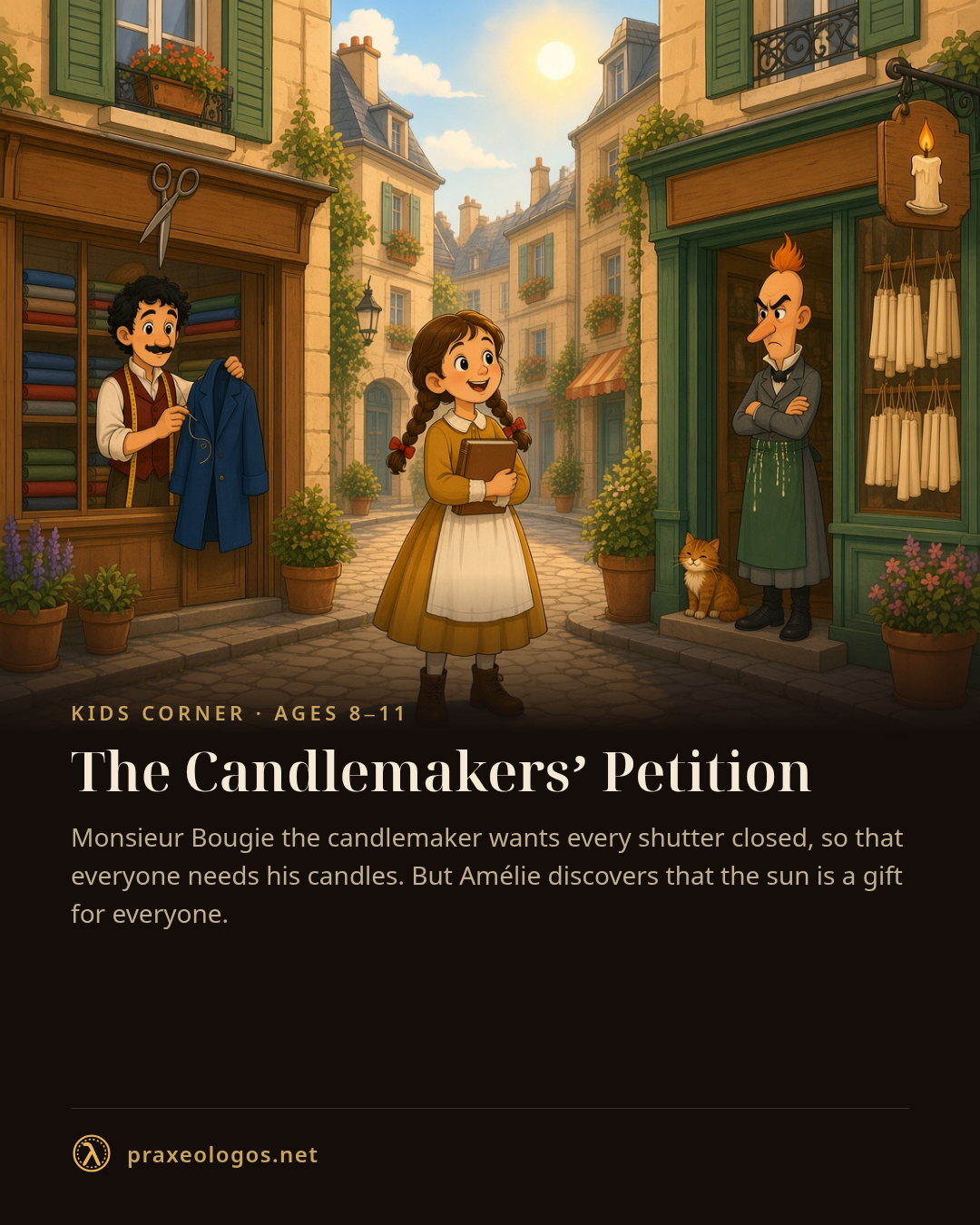
The pictures are illustrations for children, and the story is made up. Amélie, Marcel, Monsieur Bougie, Monsieur Pompon and Madame Violette are invented. In Bastiat’s text (1845), the makers of candles and lamps write to the Chamber of Deputies asking for a law that closes windows, skylights, shutters and curtains so that sunlight cannot get in, and they even claim this would bring work to shepherds, beekeepers and many others. Bastiat wrote it to make his readers laugh and think; no such law was ever passed. The tailor’s shop, the flowers, the coin jar and the sunlight let back into the Chamber are ours.