
Picture book
The Broken Window
A story inspired by Frédéric Bastiat (1850)
The characters
- Léon, an eight-year-old boy who loves his ball
- His grandma, Margot, who always sees a little further
- Monsieur Bonhomme, the baker on the square
- Gaston the glazier, who carries panes of glass on his back
- Master Gilles the shoemaker, who makes shoes
When something breaks, everybody sees the person who will fix it. But there is also someone nobody sees. Who is it? Grandma Margot knows, and she is going to show Léon.
Let’s go to a little town in France, a long, long time ago, in 1850. The story is made up, but what Léon discovers is still true today.

One morning in 1850
Léon’s ball
In a little town in France, with cobbled lanes and houses with blue shutters, there is a smell of fresh bread. It comes from Monsieur Bonhomme’s bakery. Behind his big shop window, with its many little square panes of glass, round loaves and long loaves sit in a row.
Monsieur Bonhomme comes to the door with a tray of warm loaves. “Good morning, Léon!” Léon, who is eight, is kicking his ball around the square. “Good morning, Monsieur Bonhomme! Watch this kick!”

A little later
Crash!
Léon takes a run-up and kicks with all his might. The ball flies up, up… and CRASH! It goes straight through a pane of the shop window and lands among the loaves. Little bits of glass sparkle on the cobbles.
Monsieur Bonhomme bursts out with his hands covered in flour. “My window!” he cries. Léon clutches his cheeks. “Sorry, Monsieur Bonhomme! I didn’t mean to!”

On the square
What the neighbours say
Soon the neighbours gather round. “Don’t be sad, Monsieur Bonhomme!” says the lady with the basket. “Every cloud has a silver lining!” A gentleman in a tall hat raises a finger: “Think about it: now Gaston the glazier will have work! If windows never broke, what would glaziers do?”
Everyone nods: “Quite right, quite right!” Behind a barrel, Léon listens with his mouth open. “So… I did something good?” he wonders.

At noon
Six silver francs
At noon Gaston arrives, tall and thin, with a wooden rack full of glass on his back. Whistling cheerfully, he takes out the broken bits and puts in a shiny new pane.
“Six francs, please,” he says. Monsieur Bonhomme sighs and hands him six silver coins, one by one. Gaston rubs his hands, pleased. This is what everyone sees: a new pane of glass and a happy glazier.

At home
Grandma raises an eyebrow
Léon runs home. Grandma Margot is knitting in her rocking chair by the fire. “Grandma! I broke Monsieur Bonhomme’s window, but everybody says it was a good thing! Gaston got six francs and went off whistling!”
Grandma stops knitting and raises one eyebrow. “Is that what they say? Put on your cap, Léon. I’m going to show you something that nobody sees.”

That afternoon
The baker’s shoes
Monsieur Bonhomme is sweeping up the last bits of glass. “Look at his shoes,” Grandma whispers. Léon looks: they are old and worn out. One has a big hole at the front, and the sole of the other flaps open and shut like a mouth.
“Yesterday he told me,” Grandma says softly, “that at last he had put together six francs for new shoes. This afternoon he was going to Master Gilles the shoemaker.”

At the shoemaker’s
The shoes that wait
The shoemaker’s shop smells of leather. On the counter, a pair of brand-new, shiny brown shoes is waiting. “I made them for Monsieur Bonhomme,” says Master Gilles. “But he came by a little while ago and told me he can’t take them. His six francs went on the window.”
Master Gilles spreads his hands. “What can we do? They’ll wait.” Léon looks at the shiny shoes. He hadn’t thought about Master Gilles at all.

On the bench
Window or shoes?
Grandma sits on the bench under the plane tree and lays six coins in her palm. “Before the window broke, Monsieur Bonhomme had a good window and six francs. With the six francs he would have got new shoes. So he would have had a window and shoes.”
“Now he has given his six francs to put back the window he already had. What does he have in the end?” Léon counts on his fingers. “A window… and his old shoes with holes. Nothing more than before!”

Just before evening
What you see and what you don’t
Out in the street, Gaston strolls by in the sunshine, whistling and tossing a silver coin in the air. Everyone sees him. In the shade, on the step of his shop, sits Master Gilles with the shoes on his knees. Nobody sees him.
“I get it, Grandma!” says Léon. “Gaston got the work, but Master Gilles lost it. And Monsieur Bonhomme is left without shoes!” Grandma smiles. “Well done. The neighbours only looked at what you can see. You also looked at what is hidden.”

That evening
The clay coin box
That evening, Léon opens his clay coin box. Inside are three silver francs. He had been keeping them for a wooden spinning top he saw at the toy shop; he has even drawn it on a piece of paper.
He pushes the coins forward. “I’m the one who broke the window. I’ll give Monsieur Bonhomme these three francs, and I’ll work to earn the other three.” Grandma rests her hand on his shoulder, proud. “And the spinning top?” “It will have to wait,” says Léon.

Three weeks
Buckets and baskets
For three weeks, Léon gets up early. He carries water from the fountain on the square for Madame Rosalie, his neighbour, and he carries the neighbours’ heavy baskets home for them. Each time he gets a few small copper coins.
His arms get tired and the buckets are heavy, but the coins keep adding up. By the end of the third week, the copper coins make three francs. Monsieur Bonhomme waves to him from the bakery door.

One Sunday
New shoes!
On Sunday, Léon gives Monsieur Bonhomme six francs: three from his coin box and three from his work. The baker hurries to the shoemaker’s and comes out dancing in his new shoes! Master Gilles claps, and Gaston waves from further off.
In the afternoon, Léon plays ball in the meadow outside town, far away from any windows. “You know, Grandma,” he says, “everybody can see the new shoes. But nobody can see the spinning top I didn’t get.” Grandma laughs and gives him a hug. “Now you can see what is hidden too, Léon!”
The End
The Lesson
When the window broke, everyone saw Gaston the glazier get six francs and walk off whistling. And they thought: “How nice, he has work!” But they didn’t see the shoes left waiting on Master Gilles’s counter, or Monsieur Bonhomme in his shoes with holes.
The same six francs can’t be spent twice. When something breaks, the town doesn’t get any richer: it just makes again what it already had, and something else, something we don’t see, is left waiting. That is why breaking things never gives the world more things. Things grow in number when we make them, not when we break them.
Next time you hear someone say “every cloud has a silver lining”, remember Grandma Margot: look at what you can see, but also look for what you can’t!
For grown-ups: sources and further reading
Where each page comes from
- Pages 1–12: Frédéric Bastiat, That Which Is Seen, and That Which Is Not Seen (1850), ch. 1, “The Broken Window” · French original, Ce qu’on voit et ce qu’on ne voit pas
Further reading
- Frédéric Bastiat, “That Which Is Seen, and That Which Is Not Seen” (July 1850), ch. 1, “The Broken Window”. This story starts from there: the broken window, the glazier, the six francs and the shoes are all Bastiat’s. French original: Ce qu’on voit et ce qu’on ne voit pas.
- On this site: Bastiat’s The Law, written the same year (1850), and his page among the Thinkers.
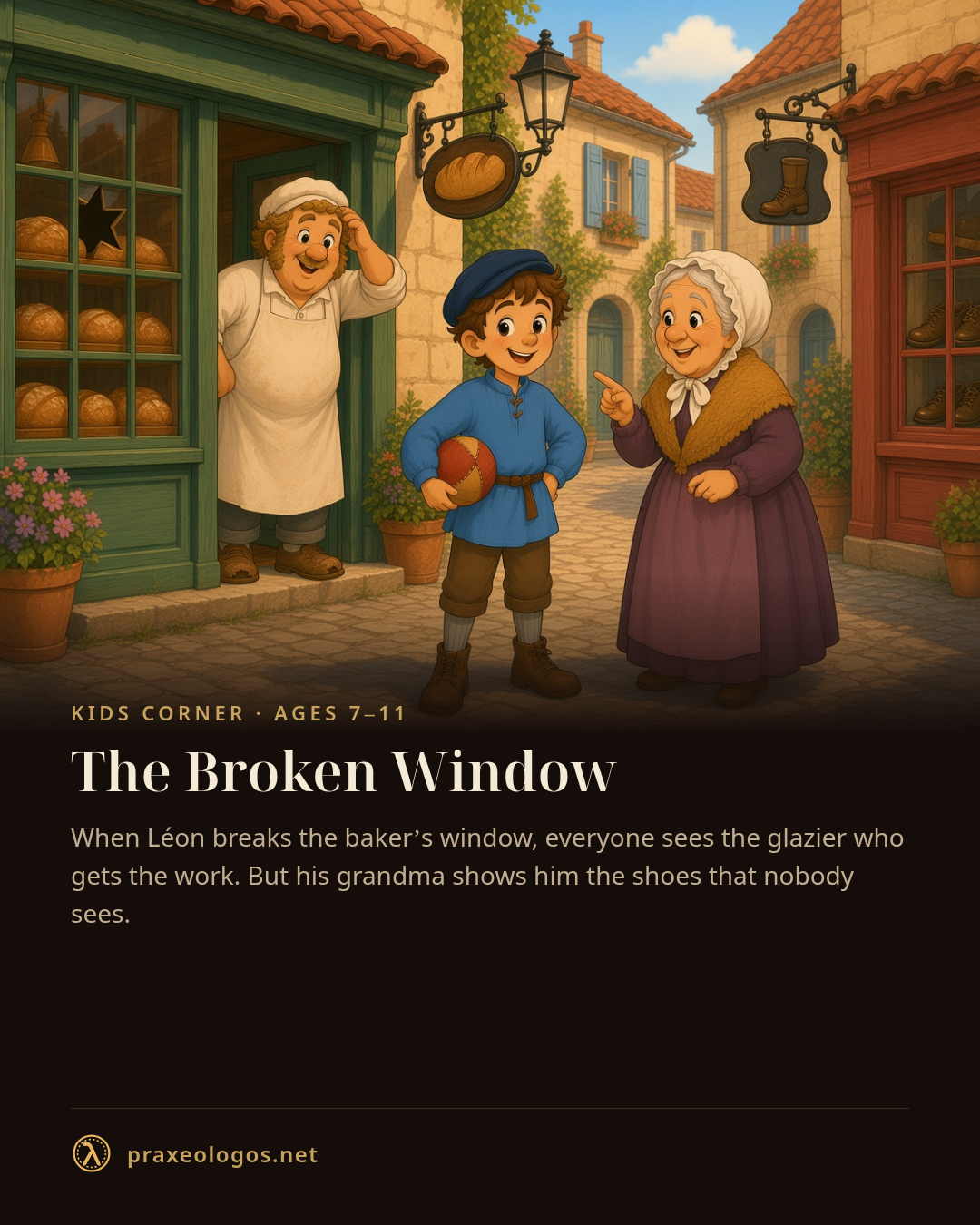
The pictures are illustrations for children, and the story is made up. Léon, Grandma Margot, Monsieur Bonhomme, Gaston, Master Gilles and Madame Rosalie are invented. In Bastiat’s text (July 1850) the window is broken by the son of a good townsman, Jacques Bonhomme; we gave his name to the baker. The six francs, the glazier and the shoes are Bastiat’s. The coin box, the spinning top and the three weeks of work are ours, so that children can see that somebody always pays for what gets broken.