

Picture book
Robinson’s Island · Book 3
The Pink Shells
The sequel to “Robinson and Friday”
The characters
- Robinson, a sailor who lives on an island and fishes with his net
- Friday, a brave sailor and the best climber on the island
- Zachary, the chatty green parrot with the red head
- Malu, Friday’s friend, who makes clay jugs
- Lani, her daughter, who weaves mats faster than anyone
- Tiko, who builds boats and paddles
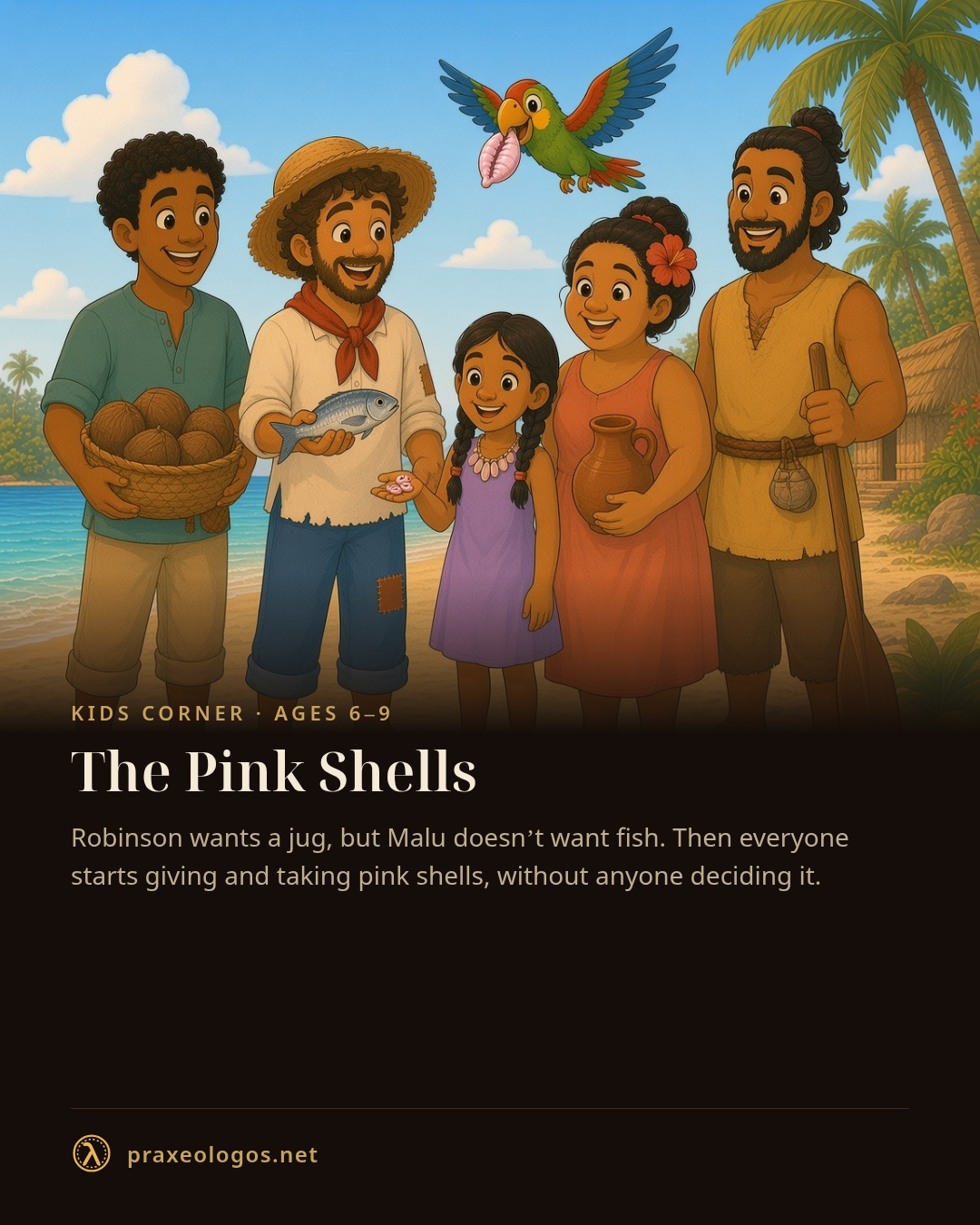
What do you do when you want a jug, but the person who makes jugs doesn’t want your fish? New friends have come to Robinson’s island, and swapping has turned into a big muddle. Until the little pink shells come along.
Remember Robinson, Friday and Zachary? At the end of the last story, Friday told them about his friends on his faraway island. Now they’re coming too! The story is made up, but this is roughly how money came about in many places around the world.
Synthetic voice: the story is read by a computer (text-to-speech), not by a person.

One morning
Sails on the horizon!
One morning, Zachary squawks from a palm branch: “Sails! Three sails on the horizon!” Three canoes are coming towards the shore, loaded with clay jugs, mats and tools. Friday runs into the shallow water, jumping for joy. “It’s my friends from my island! They’ve come to live here too!”
First onto the sand is Malu, who makes clay jugs. Behind her comes her daughter Lani, who weaves mats faster than anyone. Last out is Tiko, who builds boats and paddles. “Welcome!” calls Robinson. And Zachary squawks: “So many new friends!”

That same day
Robinson wants a jug
Robinson carries water from the spring in coconut halves, and half of it spills on the way. When he sees Malu’s jugs, his eyes light up. “What a lovely jug! I’ll give you three fish for it. What do you say?”
Malu smiles, but she shakes her head. “Thank you, but we ate fish every single day of the trip! I don’t want any more fish. What I need is a new paddle. Mine broke on the way here.” Robinson scratches his head. He has no idea how to make a paddle.

All afternoon
All around the island
So Robinson picks up his fish and sets off. Tiko makes paddles, but he doesn’t want fish. He wants a mat to sleep on. Lani weaves mats, but she doesn’t want fish either. She wants coconuts. And Friday, who gathers the coconuts? “Fish? You gave me six this morning!” he laughs from the top of his palm tree.
By the afternoon, Robinson has been all the way around the island. The jug is still on Malu’s shelf, and his fish… are starting to smell. Zachary flies beside him, pulling a face. “Phew! These fish won’t wait for anybody!”

That evening
A big muddle
In the evening, around the fire, everyone has the same problem. Tiko has carried a heavy paddle around all day, and he still has no mat. Friday tripped over a root, and his coconuts went flying out of the basket. “What a muddle! It’s worse than a tangle of string!” squawks Zachary, who is tangled up in a piece of string himself.
Lani is playing with her necklace of little pink shells, which shine in the firelight. “How pretty!” says Malu. “I’d give my best jug for a necklace like that.” “And I’d love a few to decorate the front of my boat,” says Tiko. Robinson looks at them, thinking hard.

The next day, at noon
Lani is hungry
The next day at noon, Lani is hungry, and today she really fancies some fish. “I’d like three fish,” she tells Robinson. “Shall I give you a mat for them?” “Thank you, Lani, but I already have a mat.” Lani thinks for a moment, then opens her hand. “Then would you like three pink shells?”
Robinson doesn’t want to wear a necklace. But he remembers what Malu said by the fire. “Yes, please!” he says. “Not for me, but I know someone who would love them.” He gives Lani three fish and puts the shells in his little pouch.

A little later
A jug at last!
Robinson runs to Malu. “I’ll give you three pink shells for the jug. What do you say?” “Yes, please!” says Malu, and she threads the shells onto a string straight away. Robinson fills his jug at the spring and walks back without spilling a single drop.
Zachary perches on the jug’s handle and counts on his wing. “The fish turned into shells, and the shells turned into a jug! So… your fish turned into a jug!” “Exactly,” laughs Robinson. “And Lani, who wanted my fish, got to eat them.”

At the far reef
Diving at the reef
Where do the pink shells come from? Lani and Friday take Robinson to the far reef, on the other side of the island. They dive into the deep, clear water, among corals and little coloured fish. The pink shells hide under the rocks, and there aren’t many of them.
They search all morning and find only a handful. “That’s why everyone wants them,” says Lani. “They’re pretty, they don’t break easily, they never go bad, and you can’t just pick them up wherever you like.” Zachary turns one over in his beak. “It’s like a tiny pink egg!”

Day after day
Shells for everything
Soon everyone is doing the same. Malu swaps jugs for shells, and when she has six, she uses them to get a new paddle from Tiko. Tiko gives two of them to Lani for a mat. Lani gives one to Friday for some coconuts. “Why do you take shells if you don’t wear a necklace?” asks Zachary. “Because I know everyone else will take them from me,” says Friday.
Nobody said, “From today, we pay with shells.” Nobody gave an order. They each worked it out for themselves, one swap at a time.

One afternoon
Why not fish?
One afternoon, Zachary plays teacher. He lays a fish, a coconut, a mat and a pink shell in a row on the sand. “The fish smells by evening. The coconut is heavy, and it rolls away. And you can’t cut a mat in half when you want something small.”
“And the pink shell?” asks Lani. “It’s light, it never goes bad, it fits in a pouch, and it’s easy to count: one, two, three!” says Zachary. “For something small you give one, and for something big you give lots.”

The next morning
Zachary’s white shells
Zachary has a cheeky idea. He fills a basket with white shells from the beach and drags it over to Friday. “I’ll give you all these shells for all your bananas!”
Friday bursts out laughing. “No, thank you, Zachary! White shells are everywhere. I could fill a basket myself in no time. For the pink ones, you have to dive all morning to find just a few.” Zachary’s wings droop, so Friday gives him a banana as a present.

A few days later
How many shells?
Now everyone knows how many shells to give for each thing. For a fish, one shell. For a mat, two. For a jug, three. For a paddle, six. “So a paddle is worth as much as two jugs, or six fish!” says Lani, counting on her fingers. Before, nobody could work that out so easily.
And there’s more: the shells never go bad. Robinson keeps a few in a little clay pot, for later. “Fish don’t wait,” he says. “But shells can wait as long as I like.”

One moonlit evening
A party under the moon
One moonlit evening, they all have a party on the beach. Robinson pours water from his new jug, Tiko sits on his new mat, and Malu has woven pink shells into her hair. “Who decided that we’d pay with pink shells?” asks Zachary. “Robinson? Friday?”
“Nobody!” laughs Lani. “We each took them because we knew the others would take them too.” Tiko points at the hill above the beach. “Tomorrow I’ll start building my own hut up there,” he says. And Zachary squawks: “I want a nest! How many shells for a nest?” And they all laugh under the moon.
The End
The Lesson
At first, every swap was hard. Robinson had fish, but Malu didn’t want fish. Everyone was looking for someone who had what they wanted and also wanted what they had, and most of the time they couldn’t find anyone.
Then they found something almost everyone wanted: the pink shells. They were light, they never went bad, they were easy to count, and they were hard to find. People took them even when they didn’t need them, because they knew the others would take them too. That is how the island’s money came to be. Nobody decided it, and nobody ordered it. It grew out of their swaps, one at a time.
Next time you swap something with a friend, remember the pink shells of the island: good money isn’t invented by a chief. People choose it themselves, one swap at a time.
For grown-ups: sources and further reading
Where each page comes from
- Page 1, “Sails on the horizon!”: Carl Menger, On the Origins of Money, sec. III
- Page 2, “Robinson wants a jug”: Murray N. Rothbard, What Has Government Done to Our Money?, ch. 1, sec. 2, ¶1
- Page 3, “All around the island”: Murray N. Rothbard, What Has Government Done to Our Money?, ch. 1, sec. 3, ¶2
- Page 4, “A big muddle”: Murray N. Rothbard, What Has Government Done to Our Money?, ch. 1, sec. 2, ¶1
- Page 5, “Lani is hungry”: Murray N. Rothbard, What Has Government Done to Our Money?, ch. 1, sec. 3, ¶2
- Page 6, “A jug at last!”: Carl Menger, On the Origins of Money, sec. VI
- Page 7, “Diving at the reef”: Murray N. Rothbard, What Has Government Done to Our Money?, ch. 1, sec. 3, ¶4
- Page 8, “Shells for everything”: Carl Menger, On the Origins of Money, sec. VI
- Page 9, “Why not fish?”: Murray N. Rothbard, What Has Government Done to Our Money?, ch. 1, sec. 3, ¶3
- Page 10, “Zachary’s white shells”: Murray N. Rothbard, What Has Government Done to Our Money?, ch. 1, sec. 3, ¶3
- Page 11, “How many shells?”: Murray N. Rothbard, What Has Government Done to Our Money?, ch. 1, sec. 4, ¶1
- Page 12, “A party under the moon”: Carl Menger, On the Origins of Money, sec. IX
- The Lesson: Carl Menger, On the Origins of Money, sec. VI · Murray N. Rothbard, What Has Government Done to Our Money?, ch. 1, sec. 3, ¶2 · Murray N. Rothbard, What Has Government Done to Our Money?, ch. 1, sec. 3, ¶3 · Carl Menger, On the Origins of Money, sec. IX
Further reading
- Carl Menger, On the Origins of Money: how people, each for his own good, start to accept in their swaps the things that most others accept, until one of them becomes money, with no agreement and no law (secs. III, VI and IX).
- Murray N. Rothbard, What Has Government Done to Our Money?, ch. 1: the trouble with barter, indirect exchange, and why some things (cowrie shells among them) become money (secs. 2–4).
Note
The pictures are illustrations for children, and the story is made up. Robinson and Friday are inspired by Daniel Defoe’s characters (1719); Zachary, Malu, Lani and Tiko are invented. The pink shells are like cowrie shells, which people used as money for centuries in Africa, in Asia and on the islands of the Pacific. We chose the numbers of shells ourselves, so that children can count along easily. The story follows Carl Menger’s explanation: nobody invented money; it grew out of people’s swaps.