
Picture book
The Pencil Nobody Made Alone
Based on Leonard E. Read’s essay I, Pencil
The people in the story
- Sophia, who is eight
- Her grandpa Stephen, who was once a sailor
- and the people they meet on their journey: Andrew the woodcutter, Michael at the sawmill, Daniel the miner, Katherine who makes the leads, Luke the farmer, Theodore who works with metal, Anna the farmer, James the captain, and Elizabeth and Constantine at the pencil factory
A pencil costs just a few coins. We pick it up without a second thought. And yet it hides a big secret. Leonard Read, an American writer, put it like this: in the whole world there is not a single person who knows how to make a pencil all alone!
We will travel with Sophia and her grandpa to forests and mines, fields, harbours and factories. It is a journey of the imagination, but the places and the jobs we will see are real.

At home
Who made my pencil?
Sophia is drawing at the kitchen table with a brand-new yellow pencil. Grandpa Stephen bought it for her yesterday at the little bookshop round the corner, for just a few coins. Suddenly Sophia stops and looks at it: “Grandpa, who made my pencil?”
Grandpa smiles: “Nobody on their own, but thousands of people together!” Sophia’s eyes open wide. Then Grandpa spreads his big old map on the table. “Let’s travel with our imagination and find out where every little bit of it came from!”

A forest in Oregon, in America
In the cedar forest
First stop: a forest in Oregon, in America, full of tall cedars with straight trunks. Andrew the woodcutter has just cut down a cedar and waves to them from a safe distance. Cedar wood is soft, smells lovely and is easy to sharpen. It will become the wooden body of the pencil.
But to do his job, Andrew needs a saw, a helmet, ropes and a big truck. Other people made all of these. Even the coffee he drinks in the morning was picked by someone in a faraway country. “Andrew knows how to cut down trees,” says Grandpa, “but not how to make saws or grow coffee.”

A sawmill in California
From log to little boards
The logs travel by truck and by train to a sawmill in California. There Michael and his workmates cut them into small, thin boards, each as long as a pencil. Then they dry them in a warm oven, tint them gently so that they have a nice colour, and rub them with wax.
Who made the saws, the trains and the rails? Who brings the electricity that runs the machines? Other people, whom Michael has never met. “I don’t know how to make a whole pencil either,” Michael laughs. “All I know is how to cut little boards!”

A mine in Sri Lanka
The grey stone that writes
Now the map takes them far away, to a green island called Sri Lanka. Daniel the miner comes out of the tunnel with a cart full of graphite, a shiny grey stone. He gives Sophia a little piece, and her fingers turn grey. “This stone writes!” she cries.
The graphite goes into paper sacks tied with string, and travels by ship. Some people make the sacks, others the string, others Daniel’s tools. And here is something funny: we say a pencil has a “lead”, but there is no lead metal in it at all. Its tip is made of graphite!

Where the leads are made
Graphite spaghetti
The graphite is ground into powder and mixed with clay from Mississippi, in America, and a little water. Katherine puts the mix into a machine that squeezes it out like long, thin spaghetti. The spaghetti is cut into short pieces and baked for hours in a very hot oven until they become hard leads.
At the end they are dipped in warm wax, some of which comes all the way from Mexico, so that they write smoothly. Katherine knows exactly how much clay makes a soft lead and how much makes a hard one. But she doesn’t know how to dig graphite or cut down cedars.

A field in India
A yellow coat
Sophia’s pencil wears a shiny yellow coat: six layers of varnish! In a field in India, Luke the farmer grows castor plants, tall plants with leaves like big open hands. Their seeds give an oil, castor oil, that goes into the varnish.
Luke has no idea that a little bit of his work will travel all the way to Sophia’s table. He works to bring up his children. And other people, whom we will never meet, make the yellow colour and the black paint for the letters on the pencil.

A metal works
The little golden ring
Look at the shiny little ring that holds the eraser! It is made of brass, a metal you get by melting copper and zinc together. Miners dig these two out of the ground, in other mines, in other countries.
Theodore runs the brass between big rollers until it becomes a thin, golden sheet. Thousands of little rings are cut from it. “Do you know what?” he tells Sophia. “I have never written with a pencil like this. I write with a pen!”

A field of yellow flowers
The eraser that rubs out mistakes
And the eraser? Read writes that it was made mostly from the oil of a plant with yellow flowers, rapeseed, which came from Indonesia. Anna gathers the tiny seeds, and from them comes a golden oil.
The eraser also gets a little rubber, the milky sap of a tree, to hold it together, and powdered pumice, a stone from Italy’s volcanoes, that helps it rub out. “So many places in the world fit into one tiny eraser!” says Sophia.

A big harbour
Ships, trains and trucks
All these pieces have to travel. At the harbour, James the captain shakes Grandpa’s hand. “I was a sailor too!” says Grandpa proudly. A crane lifts sacks onto the ship, and on the quay, trucks and trains full of little boards are waiting.
James doesn’t know what is inside every sack. But he knows how to take his ship safely from harbour to harbour. He is helped by the pilots, who guide ships into harbour, and by the lighthouse keepers, who light the lighthouses at night. Without knowing it, they too helped to make Sophia’s pencil.

At the pencil factory
The pencil sandwich
At last, everything arrives at the pencil factory! One machine cuts eight grooves into each little board. Another lays the leads in them, spreads glue and covers them with a second board, like a sandwich. The sandwich is cut into eight pencils, which are painted yellow and get their ring and eraser. Elizabeth gives Sophia and Grandpa a brand-new one each.
Who knows how to do all of this? Constantine, the head of the factory, spreads his hands and laughs: “Me? Even I don’t know how to make a pencil on my own! I can’t cut down cedars, or dig graphite, or make brass. I only know my own small part.”

Back home
A web around the world
Sophia pins the map on the wall and, with coloured strings, joins up all the places on their journey. Soon the map looks like a spider’s web! Andrew, Daniel, Anna, Luke and so many others live very far from one another. They speak different languages and have never met.
Nobody gave them orders. Nobody sat somewhere arranging everything for everyone. Each of them did their own job well, for their own reasons: Andrew to buy his son a bicycle, Anna to put a new roof on her house. And yet, all together, they made Sophia’s pencil!

That evening
A letter for everyone
That evening Sophia sits at the table and writes a letter: “Thank you, all of you who made my pencil: Andrew, Michael, Daniel, Katherine, Luke, Theodore, Anna, James, Elizabeth, Constantine… and everyone I don’t know!” She draws a big heart, too.
Grandpa reads the letter and secretly wipes away a tear. “And do you know who helped you write it?” he asks. Sophia looks at the pencil in her hand and laughs: “All of them!”
The End
The Lesson
A simple pencil was made by thousands of people, in many countries, who don’t know one another. Not one of them knows how to make it alone, not even the head of the factory. Each of them knows one small part well, and nobody had to give orders to all the others.
Most of them didn’t work because they wanted a pencil. They worked for their own lives and their families, and with the money from their work they got the things they needed. When people are free to do the work they know and to swap what they make in peace, together they achieve wonders that nobody could manage alone.
Next time you pick up a pencil, remember: you are holding the work of the whole world in your hands!
For grown-ups: sources and further reading
Where each page comes from
- Page 1, “Who made my pencil?”: Leonard E. Read, I, Pencil, opening
- Page 2, “In the cedar forest”: Leonard E. Read, I, Pencil, “Innumerable Antecedents”, ¶2
- Page 3, “From log to little boards”: Leonard E. Read, I, Pencil, “Innumerable Antecedents”, ¶3–4
- Page 4, “The grey stone that writes”: Leonard E. Read, I, Pencil, “Innumerable Antecedents”, ¶7
- Page 5, “Graphite spaghetti”: Leonard E. Read, I, Pencil, “Innumerable Antecedents”, ¶8
- Page 6, “A yellow coat”: Leonard E. Read, I, Pencil, “Innumerable Antecedents”, ¶9–10
- Page 7, “The little golden ring”: Leonard E. Read, I, Pencil, “Innumerable Antecedents”, ¶11
- Page 8, “The eraser that rubs out mistakes”: Leonard E. Read, I, Pencil, “Innumerable Antecedents”, ¶12
- Page 9, “Ships, trains and trucks”: Leonard E. Read, I, Pencil, “Innumerable Antecedents”, ¶5 and ¶7
- Page 10, “The pencil sandwich”: Leonard E. Read, I, Pencil, “Innumerable Antecedents”, ¶6 · “No One Knows”, ¶2
- Page 11, “A web around the world”: Leonard E. Read, I, Pencil, “No One Knows”, ¶3 · “No Master Mind”, ¶1
- Page 12, “A letter for everyone”: Leonard E. Read, I, Pencil, opening: “We are perishing for want of wonder…”
Further reading
- Leonard E. Read, I, Pencil: the whole short essay, in which the pencil itself tells its story.
- Leonard E. Read, I, Pencil, “No Master Mind”: why no single person directs it all.
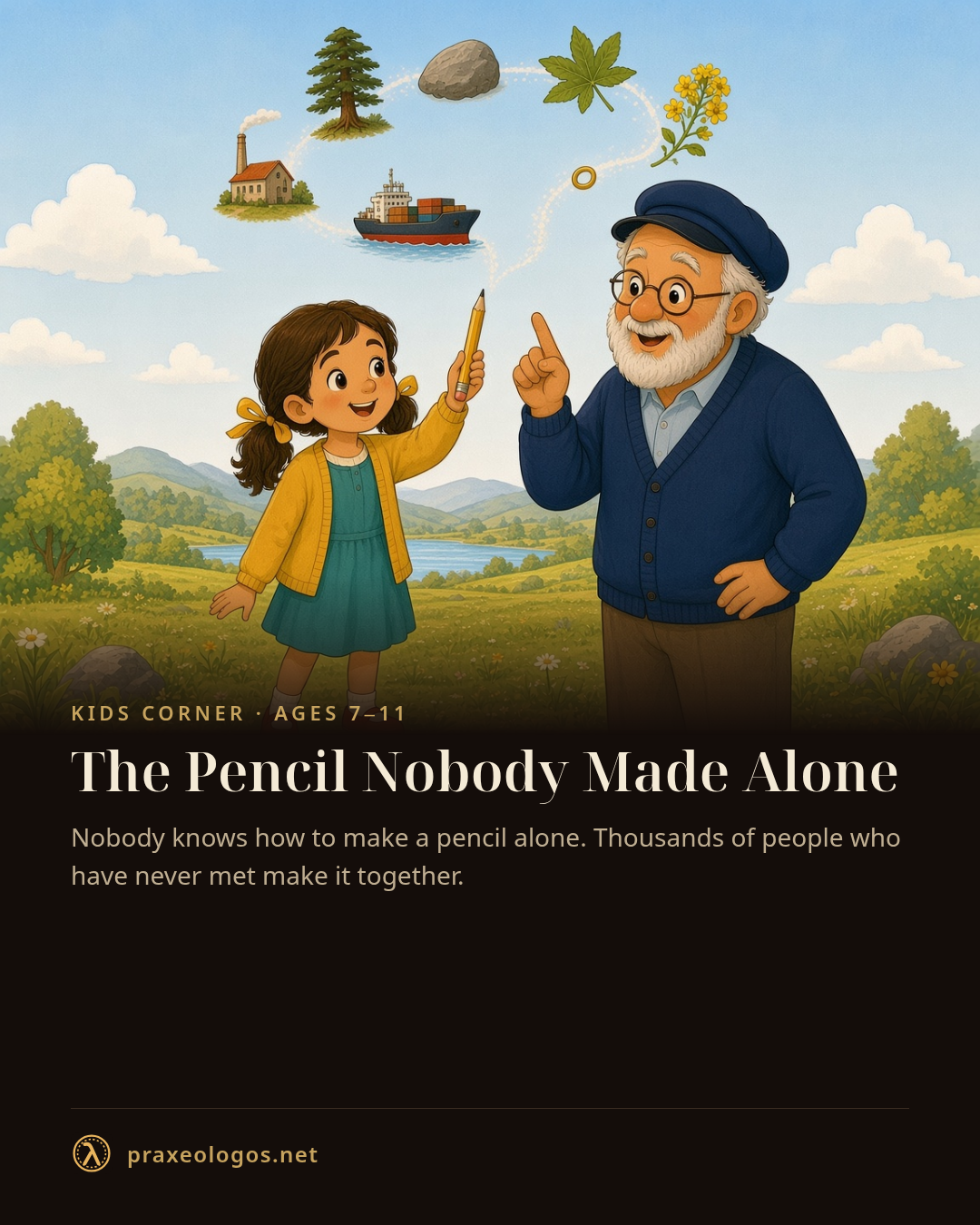
The pictures are illustrations for children, and the journey happens in the imagination. The names of the people are made up. The places (Oregon, California, Sri Lanka, Mississippi, Mexico, Indonesia, Italy) are the ones Read names in his 1958 essay; we chose India for the castor plants because most of them are grown there today. Today pencils are made in many countries, and their materials come from many places.