
Picture book
Robinson’s Net
A story inspired by Robinson Crusoe
The characters
- Robinson, a sailor who finds himself alone on an island
- Zachary, a chatty green parrot with a red head
What do you do when you are alone on an island and hungry? You catch fish with your hands, of course! But what if you want to catch many more? Then you have to do something hard: eat a little less today, so that you can make something that will help you for a long time.
Let’s meet Robinson and his friend, Zachary the parrot. The story is made up, but what they discover is true for all of us.

One morning, after the storm
Alone on an island
After a big storm, Robinson’s little ship is stuck on the rocks. Robinson has swum to the shore of a small island where nobody lives. Now he wakes up on the sand, with his straw hat beside him, and looks around: palm trees, blue sea and… two round eyes watching him from a branch.
“Who are you?” asks a green parrot with a red head. “I’m Robinson.” “And I’m Zachary!” says the parrot. “Welcome to my island. Are you hungry?” Robinson’s tummy rumbles loudly. “Very!”

In the shallow sea
Fishing with bare hands
Lots of fish swim in the shallow, warm sea. Robinson wades in up to his knees and… splash! A fish slips through his fingers. Splash! And another one. On a rock, Zachary holds his tummy, laughing.
Robinson keeps trying from morning till evening. By the end of the day he has caught three little fish. “Three fish for a whole day!” he sighs. “That’s only enough for supper.”

That evening
The spider’s web
They grill the little fish over the fire, under the stars. Then Robinson notices something among the branches: a big spider’s web glowing in the firelight. “Look, Zachary! The spider doesn’t chase every fly. It makes a web, and the flies get caught all by themselves!”
Robinson’s eyes light up. “I’ll make a web for fish too: a net! With a net I’ll catch lots of fish at once.” Zachary tilts his head. “And how long will it take you to make it?” “Many days, I’m afraid…”

The days that follow
A little less today
“If I spend all day making the net, when will I catch fish? What will I eat?” Robinson wonders. So he comes up with a plan. For a few days he fishes just as before, but he eats two fish instead of three. He hangs the third one on a wooden rack to dry in the sun, so that it keeps for a long time.
He also gathers coconuts and bananas and keeps them in the shade of his hut. “Two fish instead of three? Your tummy will grumble!” says Zachary. “Only a little,” laughs Robinson. “Every fish I keep today will feed me on the days I spend making the net.”

Under the palm trees
String from coconuts
Now Robinson fishes only a little, early in the morning. The rest of the time he sits under the palm trees and pulls the brown fibres off the shaggy coconut husks. He twists them between his fingers until they become a strong string.
Zachary wants to help. He grabs the end of the string with his beak and pulls. “Hey, this isn’t tug-of-war!” laughs Robinson. Little by little the string grows longer, because a net needs an awful lot of string.

Day after day
Knot by knot
Then the knots begin. Robinson sits on a little stool in the shade of the hut and ties knot after knot, little hole after little hole. When he concentrates, his tongue pokes out a little. Every evening he scratches a line on the palm trunk to count the days.
For food, Robinson has the dried fish and the coconuts he kept, and Zachary eats the bananas. Day by day there are fewer fish on the rack. But the net keeps growing!

One rainy evening
Shall we give up?
One evening it rains hard. Robinson’s fingers ache from all the knots, and of all the fish he kept, only one little dried fish is left. Zachary, soaking wet and grumpy, cries: “Let’s give up! Go and catch fish with your hands, like before!”
Robinson rubs his fingers and smiles. “If I stop now, all these days will be wasted. It’s nearly done, Zachary. Just two more days.” Zachary puffs up his feathers. “Fine… but only two!”

The tenth day
The net is ready!
On the tenth day Robinson ties the last knot. Along the top of the net he ties empty coconut shells, so that it floats, and along the bottom small stones, so that it hangs straight down in the water. He stretches it out between two palm trees: it is big and strong, with hundreds of little square holes!
“Ten lines on the palm tree!” counts Zachary, hopping on top of the net. “Ten days of small meals and sore fingers,” says Robinson proudly. “Tomorrow we’ll find out if they were worth it.”

The next morning
Splash, splash, splash!
The next morning Robinson casts the net into the shallow sea and waits a little. When he pulls it in, it is so heavy that he can hardly lift it. Dozens of silver fish are jumping inside! Zachary flies above him, squawking with joy.
By midday Robinson has caught thirty fish. “Thirty!” he shouts. “With my hands it took me ten whole days to catch that many!” And he gives us a wink.

A quiet afternoon
An afternoon in the hammock
Now Robinson fishes for just one morning and has fish for many days. He spreads them on the rack, and they dry in the sun. With the string left over, he weaves a hammock and hangs it between two palm trees.
Zachary lies down beside him, wings behind his head. “Remember when you fished from morning till evening for three little fish?” “I remember,” says Robinson. “Now the net does the hard work, and I have time for other things too.”

Every evening at dusk
A net needs looking after
Every evening at dusk Robinson checks his net. If he finds a torn hole, he mends it with a little new string before it gets bigger. Zachary brings him the string in his beak. “If we look after it,” says Robinson, “it will last us a long time.”
With the time he has left over, Robinson has woven a basket and is carving a big log into a boat. “Another job that takes many days?” asks Zachary. “Yes,” says Robinson. “With a boat we can fish out in the deep water too!”

A little while later
Worth every knot
A little while later, the boat is ready. In the evening they have a party on the beach: fish on the fire for Robinson, bananas for Zachary and cool coconut water for them both. “Remember the days when we were hungry and tied knots?” asks Robinson.
“Worth every knot!” squawks Zachary. Robinson raises his coconut: “Tomorrow we’ll sail all the way round the island in our boat!” Zachary thinks for a moment and says: “Then tonight let’s keep a few fish for the trip!” And they both laugh under the first star.
The End
The Lesson
With his hands, Robinson caught three fish a day. To make the net, he first had to eat a little less and put food aside for the days when he wouldn’t be fishing. It was hard, and nobody promised him that it would work.
But once the net was ready, he caught in one morning as many fish as he used to catch in ten days, and he had time left over for a hammock, a basket and a boat. Life works like that too: good tools don’t fall from the sky. Someone makes them, after first keeping something for tomorrow instead of eating it all today. And tools need looking after, so that they keep helping us for a long time.
Next time you keep something for tomorrow, or work hard for something that takes a while, remember Robinson and Zachary: it was worth every knot!
For grown-ups: sources and further reading
Where each page comes from
- Page 1, “Alone on an island”: Murray N. Rothbard, Man, Economy, and State, ch. 1, sec. 9, ¶2
- Page 2, “Fishing with bare hands”: Murray N. Rothbard, Man, Economy, and State, ch. 1, sec. 9, ¶2
- Page 3, “The spider’s web”: Murray N. Rothbard, Man, Economy, and State, ch. 1, sec. 9, ¶4 · Murray N. Rothbard, Man, Economy, and State, ch. 1, sec. 9, ¶10
- Page 4, “A little less today”: Murray N. Rothbard, Man, Economy, and State, ch. 1, sec. 9, ¶4 · Murray N. Rothbard, Man, Economy, and State, ch. 1, sec. 9, ¶15
- Page 5, “String from coconuts”: Murray N. Rothbard, Man, Economy, and State, ch. 1, sec. 9, ¶4
- Page 6, “Knot by knot”: Murray N. Rothbard, Man, Economy, and State, ch. 1, sec. 9, ¶4 · Murray N. Rothbard, Man, Economy, and State, ch. 1, sec. 9, ¶12
- Page 7, “Shall we give up?”: Murray N. Rothbard, Man, Economy, and State, ch. 1, sec. 9, ¶39
- Page 8, “The net is ready!”: Murray N. Rothbard, Man, Economy, and State, ch. 1, sec. 9, ¶4
- Page 9, “Splash, splash, splash!”: Murray N. Rothbard, Man, Economy, and State, ch. 1, sec. 9, ¶4 · Murray N. Rothbard, Man, Economy, and State, ch. 1, sec. 9, ¶9
- Page 10, “An afternoon in the hammock”: Murray N. Rothbard, Man, Economy, and State, ch. 1, sec. 9, ¶9
- Page 11, “A net needs looking after”: Murray N. Rothbard, Man, Economy, and State, ch. 1, sec. 9, ¶23 · Murray N. Rothbard, Man, Economy, and State, ch. 1, sec. 9, ¶10
- Page 12, “Worth every knot”: Murray N. Rothbard, Man, Economy, and State, ch. 1, sec. 9, ¶15 · Murray N. Rothbard, Man, Economy, and State, ch. 1, sec. 9, ¶17
Further reading
- Murray N. Rothbard, Man, Economy, and State, ch. 1, sec. 9: the classic example of Robinson on a desert island, who picks berries by hand and makes a long stick to shake them off the trees. This story starts from that idea.
- In the same section, Rothbard also explains why it is worth repairing a tool, just as Robinson mends his net: Man, Economy, and State, ch. 1, sec. 9, ¶23.
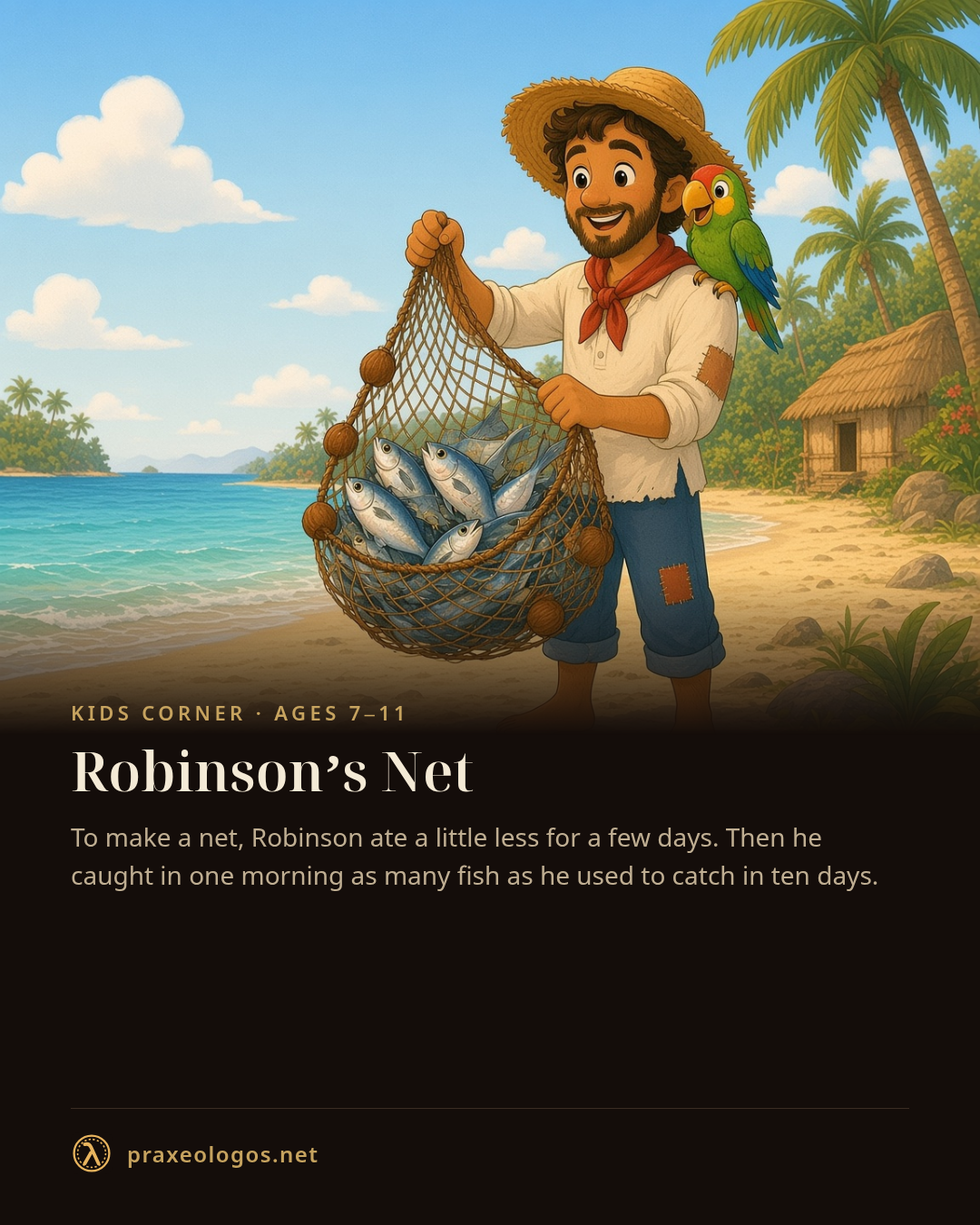
The pictures are illustrations for children, and the story is made up. Robinson is inspired by Daniel Defoe’s hero (1719); Zachary is invented. Economists of the Austrian School often use the example of Robinson on a desert island. Rothbard writes about berries and a stick, and notes that to catch fish you need a pole or a net; we chose the net. The numbers (three fish a day, ten days, thirty fish) are ours, so that children can count along easily.