

Picture book
Robinson and Friday
The sequel to “Robinson’s Net”
The characters
- Robinson, a sailor who lives on an island and fishes with his net
- Friday, a brave sailor from a faraway island, who climbs palm trees like a squirrel
- Zachary, the chatty green parrot with the red head
What happens when two friends are good at different things? Robinson catches fish with his net. Friday climbs the tallest palm trees. Could they have more together than each of them would have alone?
Remember Robinson and Zachary from “Robinson’s Net”? One morning, a new friend arrives on their island. The story is made up, but what they discover is true for all of us.

One morning, at sunrise
A sail on the horizon
One morning, Zachary squawks from Robinson’s shoulder: “A sail! A sail on the horizon!” A narrow canoe, with a long log on one side so that it won’t tip over, is coming towards the shore. Its mast is broken and its sail has fallen down.
A young man jumps into the shallow water and pulls the canoe towards the sand. “Hello! My name is Friday. I come from an island beyond the horizon. The wind broke my mast. May I stay for a little while, until I fix it?” “Of course!” says Robinson. “Come and eat with us.”

The first days
Robinson’s day
In the first days, each of them looks after his own food. In the morning, Robinson casts his net into the sea and catches six fish. In the afternoon he wants some coconuts too, so he tries to climb a tall palm tree.
He climbs a little way… and slides back down! Up he goes again… and down he slides again, while his hat flies off into the air. Zachary hides his giggles behind his wing. By evening, Robinson has gathered just one coconut. “Six fish and one coconut,” he sighs.

That same day
Friday’s day
In the morning, Friday fishes with his wooden spear. But the fish are quick, and by midday he has caught three. In the afternoon he ties a loop of rope around his feet and… whoosh! Up he goes to the top of the palm tree, like a squirrel.
Down come the coconuts, one after another: thud, thud, thud! Robinson watches with his mouth open. By evening, Friday has gathered nine coconuts. “Three fish and nine coconuts,” he says. “Your fish are far too quick for me!”

That evening
Zachary counts
In the evening, by the fire, Zachary lays two big leaves on the sand. On one he puts Robinson’s fish and coconut. On the other, Friday’s fish and coconuts. “Six fish and one coconut here. Three fish and nine coconuts there,” he counts, just like a teacher.
“Robinson is good at fishing, and Friday is good at climbing,” says Zachary. “So why are you each doing everything on your own?” Friday raises a finger: “I have an idea! Tomorrow you fish all day, and I climb all day. In the evening we’ll see what we have.”

The next day
Each does what he does best
The next day, Robinson doesn’t climb a single palm tree. He casts his net in the morning and again in the afternoon, and he catches twelve fish!
Friday doesn’t touch his spear at all. He climbs from palm tree to palm tree all day long, and the big basket fills up: eighteen coconuts! Zachary flies around the treetops and points his wing at the coconuts that are ready to drop.

At sunset
The big swap
At sunset they look at their pile: twelve fish and eighteen coconuts! When they each did everything on their own, between them they had only nine fish and ten coconuts. “Let’s swap,” says Robinson. “I’ll give you six fish, and you give me nine coconuts. Would you like that?” “Yes, I would!” says Friday, and they shake hands.
Now each of them has six fish and nine coconuts. Robinson had only one coconut, and now he has nine! Friday had three fish, and now he has six! Nobody lost anything, and both have more than before. “Magic!” squawks Zachary. “It isn’t magic,” laughs Friday. “We each did what we do best.”

One morning
“No, thank you!”
One morning, Robinson is in a joking mood. He holds up a fish by its tail and says: “Friday, I’ll give you this one fish for your whole basket of coconuts!”
Friday bursts out laughing. “No, thank you! I won’t give a whole basket for one fish.” Zachary laughs so hard that he nearly falls off his branch. “That’s how it works,” says Robinson. “A swap only happens when we both want it. If one of us says no, it doesn’t happen.” And in the end they agree, just like before: six fish for nine coconuts.

In the shade of the palms
Better at both
It’s time to fix Friday’s canoe. They need a new mast made from a straight tree trunk, and lots of rope for the sail. They sit in the shade and twist coconut fibres into rope, just as Robinson did for his net.
Soon there is lots of rope in front of Friday, but only a small coil in front of Robinson. Robinson scratches his head. “You’re better at making rope too? And you’re much better than me at carving wood. So what should I do?” Zachary tilts his head and looks at one coil and then at the other.

Day after day
The new mast
“I’m a little better than you at making rope,” says Friday. “But at carving I’m much, much better. If I do both on my own, it will take a very long time. If you twist the rope and I carve the mast, we’ll finish much sooner!”
And that’s what they do. Friday shapes the trunk with his stone axe, and wood shavings fall onto the sand. Robinson twists rope, and Zachary holds the end in his beak to keep it straight. Day by day, the mast gets smoother and the rope gets longer.

One sunny day
Free to sail away
One sunny day, the canoe is ready, with a new mast and strong rope. They take it on a trial trip around the island. Friday sits at the back and steers with the paddle, Robinson waves his hat, and Zachary perches high up on the sail.
When they get back, Robinson asks, a little sadly: “Will you leave now?” Friday smiles. “I’m free to leave whenever I like. But I’ll stay a little longer. Together we have more fish, more coconuts and more fun!”

In the afternoons
Learning from each other
Because each of them does what he does best, they finish their work earlier, and in the afternoons they have time left over. Robinson shows Friday how to tie the knots of the net. “Knot by knot, little hole by little hole,” he says.
Then Friday hangs a loop of rope on a low palm tree that leans over the sand. “Tomorrow I’ll teach you to climb,” he says. Zachary sits on the trunk and laughs: “I want to see that!” Robinson laughs too: “But you’ll always be the best climber on the island!”

One moonlit evening
A party under the moon
One moonlit evening they have a party on the beach: fish on the fire, cool coconut water, and bananas for Zachary. Robinson and Friday clink their coconuts together. “To the best fisherman!” “To the best climber!”
Friday points far out across the sea. “Lots of people live on my island, and each of them is good at something different: one makes clay jugs, another weaves mats, another builds boats. Would you like to come with me?” Zachary spreads his wings: “So many friends? Just imagine how many swaps!” And all three of them laugh under the moon.
The End
The Lesson
Robinson and Friday were not good at the same things. When each of them did everything on his own, together they had nine fish and ten coconuts. When each of them did what he did best, they had twelve fish and eighteen coconuts. Then they swapped, and both of them had more than before.
The swap happened because they both wanted it. Nobody forced them, and each of them could say “No, thank you.” And one more thing: even when someone is better at everything, like Friday with the rope and the mast, it is worth doing the thing he is much better at and leaving the other job to his friend. That way everybody finishes sooner.
Next time you share a job with a friend, or swap something at break time, remember Robinson, Friday and Zachary: together, each of us has more!
For grown-ups: sources and further reading
Where each page comes from
- Page 1, “A sail on the horizon”: Murray N. Rothbard, Man, Economy, and State, ch. 2, sec. 3, ¶1
- Page 2, “Robinson’s day”: Murray N. Rothbard, Man, Economy, and State, ch. 2, sec. 3, ¶5
- Page 3, “Friday’s day”: Murray N. Rothbard, Man, Economy, and State, ch. 2, sec. 3, ¶5
- Page 4, “Zachary counts”: Murray N. Rothbard, Man, Economy, and State, ch. 2, sec. 3, ¶1 · Murray N. Rothbard, Man, Economy, and State, ch. 2, sec. 3, ¶5
- Page 5, “Each does what he does best”: Murray N. Rothbard, Man, Economy, and State, ch. 2, sec. 3, ¶5
- Page 6, “The big swap”: Murray N. Rothbard, Man, Economy, and State, ch. 2, sec. 2, ¶2 · Murray N. Rothbard, Man, Economy, and State, ch. 2, sec. 3, ¶5
- Page 7, “No, thank you!”: Murray N. Rothbard, Man, Economy, and State, ch. 2, sec. 2, ¶2 · Murray N. Rothbard, What Has Government Done to Our Money?, ch. 1, ¶1
- Page 8, “Better at both”: Murray N. Rothbard, Man, Economy, and State, ch. 2, sec. 3, ¶6
- Page 9, “The new mast”: Murray N. Rothbard, Man, Economy, and State, ch. 2, sec. 3, ¶6 · Murray N. Rothbard, Man, Economy, and State, ch. 2, sec. 3, ¶7
- Page 10, “Free to sail away”: Murray N. Rothbard, Man, Economy, and State, ch. 2, sec. 2, ¶1 · Murray N. Rothbard, Man, Economy, and State, ch. 2, sec. 2, ¶2
- Page 11, “Learning from each other”: Murray N. Rothbard, Man, Economy, and State, ch. 2, sec. 3, ¶14
- Page 12, “A party under the moon”: Murray N. Rothbard, Man, Economy, and State, ch. 2, sec. 3, ¶8 · Murray N. Rothbard, Man, Economy, and State, ch. 2, sec. 3, ¶9
- The Lesson: Murray N. Rothbard, Man, Economy, and State, ch. 2, sec. 3, ¶5 · Murray N. Rothbard, Man, Economy, and State, ch. 2, sec. 3, ¶6 · Murray N. Rothbard, Man, Economy, and State, ch. 2, sec. 3, ¶7 · Murray N. Rothbard, Man, Economy, and State, ch. 2, sec. 2, ¶2
Further reading
- Murray N. Rothbard, Man, Economy, and State, ch. 2, sec. 3: why two people who are good at different things both have more when each does what he does best and then they swap, even when one of them is better at everything (¶6–7).
- Murray N. Rothbard, What Has Government Done to Our Money?, ch. 1: Crusoe and Friday swap fish for lumber, and every swap happens because both of them expect to gain from it.
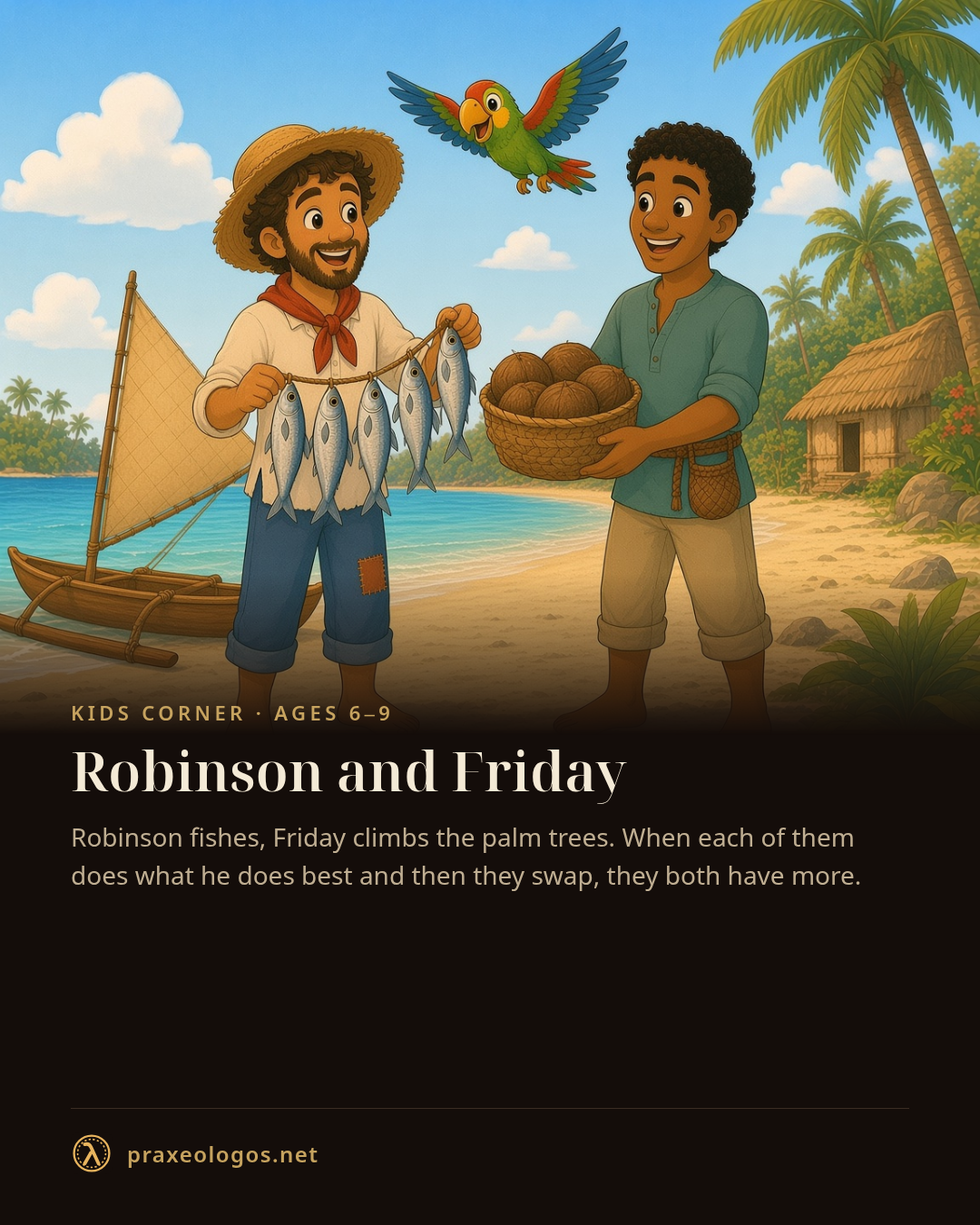
The pictures are illustrations for children, and the story is made up. Robinson and Friday are inspired by Daniel Defoe’s characters (1719); Zachary is invented. In the novel, Robinson gives Friday his name and makes him his servant. Here we imagined them differently: Friday has his own name, his own canoe and his own skills, and the two are equals, friends who work together and swap freely. Economists of the Austrian School often use the example of Robinson and Friday. The numbers of fish and coconuts are ours, so that children can count along easily.