
Picture book
How Money Came to Be
Based on Carl Menger’s essay On the Origin of Money
The people in the story
- Nicholas the fisherman
- Peter, who makes stone axes
- Helen, who has grain
- and friends from other times: Mary the weaver, Joseph the merchant, Demetrius the craftsman, Thomas the goldsmith and John the merchant
Today we hand over a few coins or tap a card, and we get bread. But once there was no money at all. Who invented it? Carl Menger, a wise economist from Austria, gives a simple and surprising answer: nobody!
We will follow money from the first villages to the first paper notes that everyone took as money. On every page the times change, but the reason stays the same: everyone is looking for an easier way to get what they need.

Neolithic period
The fisherman needs an axe
Nicholas the fisherman has caught a big, shiny fish. Now he wants a stone axe to chop wood. He goes to Peter, who makes the best axes in the village. “I’ll give you my fish for an axe!” he says. Peter smiles and shakes his head: “Thank you, but I don’t want fish. I want grain!” What a shame! For the trade to happen, each of them must want exactly what the other has, and at the very same time. That rarely happens.
That is the big problem when people swap one thing for another. Carl Menger noticed it: many trades that would make both people happy never happen at all.

Neolithic period
A clever detour
Nicholas thinks and thinks. Then he sees Helen, who has a basket full of grain. “Would you like a fish?” he asks. “Very much!” she replies. Nicholas gives her the fish and takes the grain, even though he does not need it himself. Then he runs to Peter, gives him the grain and at last gets his axe!
With two trades he managed what he could not do with one. Almost everyone needs grain and it does not spoil quickly, so people accept it gladly: it is easier to sell than fish. Nicholas found a clever way: he took something he did not want, so that he could then get what he did want.

Ancient herding peoples
Something everyone accepts
Among many ancient peoples who lived with their herds, everyone wanted cattle. Mary the weaver gives her colourful cloth for an ox. Does she need an ox? No! But she knows that later she can easily trade it for something else. The ox has become something everyone will take, so you can get what you want.
The more people accept a thing, the more easily it passes from hand to hand. And the more easily it passes, the more people accept it. Nobody decided this: people saw that others were doing better and did the same. Language still remembers that time: in Latin, money is pecunia, from the word pecus, which means “herd”.

Mesopotamia, 2nd millennium BC
Silver on the scales
But an ox cannot be cut in two! It does not travel easily, and it can fall ill. In the cities of Mesopotamia, merchants are paid more and more often in silver: rings, coils of wire and little pieces. Joseph the merchant weighs it carefully on his scales at every payment.
Silver is ideal: it does not spoil, it can be cut into small pieces without losing value, it is easy to carry, and it is wanted everywhere. That is why, as Menger explains, the precious metals, like silver and gold, in time became money among all the peoples who traded a lot.

Lydia, 7th century BC
The stamp came later
In Lydia, in the seventh century BC, Demetrius the craftsman strikes a stamp with his hammer onto small lumps of electrum. Electrum is a metal found in nature: a mix of gold and silver. The stamp has a lion’s head and shows everyone that the lump has the right weight and is pure. This is how the first coins are born, and nobody has to weigh the metal at every payment any more.
Yet the rulers did not invent money; they found it already in use. People had been paying in metal for centuries. As Menger says, the rulers only made better something that people had already worked out by themselves in the market.

London, 17th century
From metal to paper
In seventeenth-century London, John the merchant leaves his gold with Thomas the goldsmith for safekeeping. Thomas gives him a piece of paper, a receipt: “With this, you can take your gold back whenever you like.” Soon people pay with the receipt instead of the gold, because whoever holds it can go and collect the gold.
Europe’s paper notes, which everyone took as money, grew out of receipts like these. The paper had value because you could swap it for gold, a money people had already chosen. Later, states cut that link. Today’s money can no longer be swapped for gold, yet it inherited its value from gold.
The End
The Lesson
Nobody invented money! Each person thought only about their own problem: how to get what they needed. So they accepted the thing that passed most easily from hand to hand. Those who did so did better; others copied them, until one thing was accepted by everyone. Nobody planned it: money grew all by itself, out of what all these people did together.
The state came later. It could stamp money, make rules for it and, in the end, replace it with paper. Yet even its paper took its value from a money that people in the market had already chosen.
For grown-ups: sources and further reading
Where each page comes from
- Page 1, “The fisherman needs an axe”: Carl Menger, On the Origin of Money, III · Murray N. Rothbard, What Has Government Done to Our Money?, I.2
- Page 2, “A clever detour”: Carl Menger, On the Origin of Money, VI · Murray N. Rothbard, What Has Government Done to Our Money?, I.3
- Page 3, “Something everyone accepts”: Carl Menger, On the Origin of Money, VI · Murray N. Rothbard, What Has Government Done to Our Money?, I.3
- Page 4, “Silver on the scales”: Carl Menger, On the Origin of Money, VIII · Murray N. Rothbard, What Has Government Done to Our Money?, I.3
- Page 5, “The stamp came later”: Carl Menger, On the Origin of Money, IX · Murray N. Rothbard, What Has Government Done to Our Money?, I.6
- Page 6, “From metal to paper”: Murray N. Rothbard, What Has Government Done to Our Money?, I.12 · Ludwig von Mises, Human Action, XVII, §4
Further reading
- Carl Menger, On the Origin of Money: the whole short essay.
- Ludwig von Mises, Human Action, XVII, §§3–4: the significance of Menger’s theory.
- Murray N. Rothbard, What Has Government Done to Our Money?, II.1–4: from trading to money, in plain language.
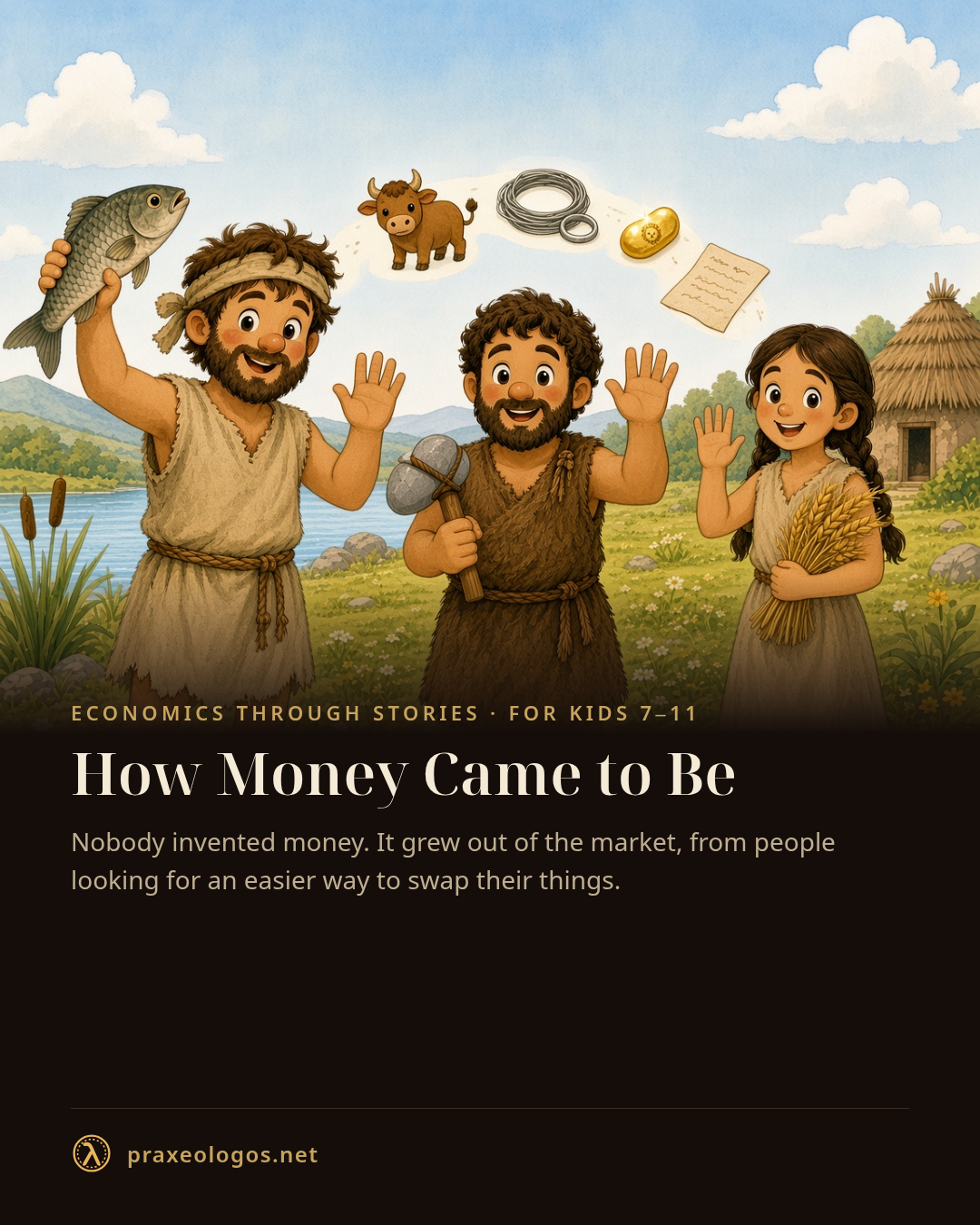
The pictures are illustrations for children, not faithful historical reconstructions. The first two pages are a hypothetical example, and the names of the people are made up. The rest present, in simplified form, well-known milestones in the history of money; these did not follow one another in the same way everywhere.